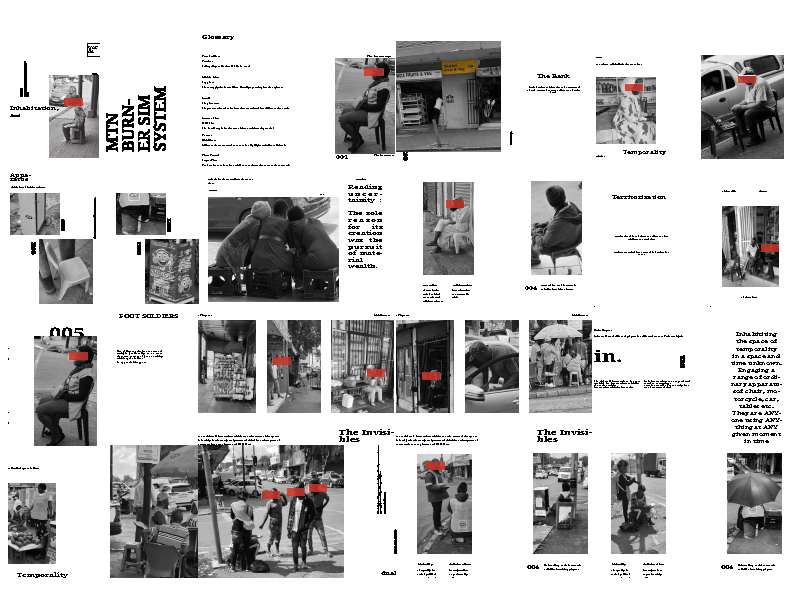
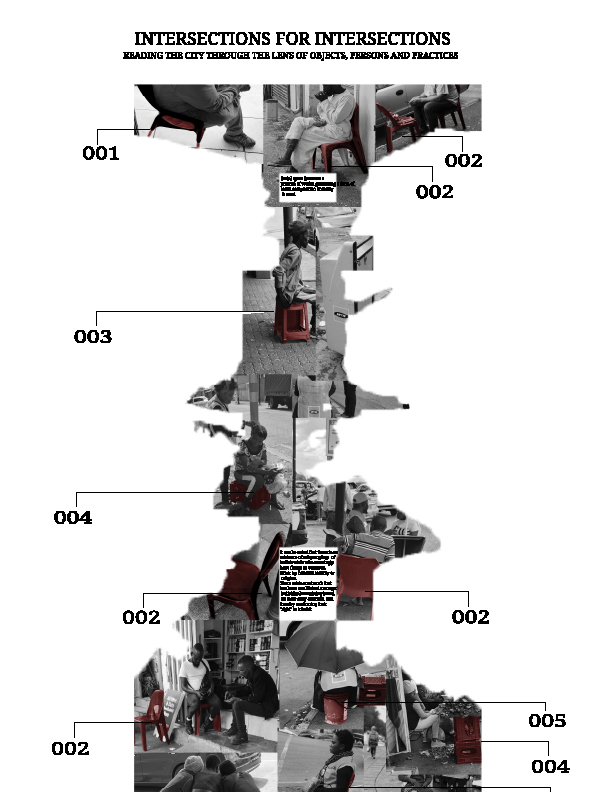
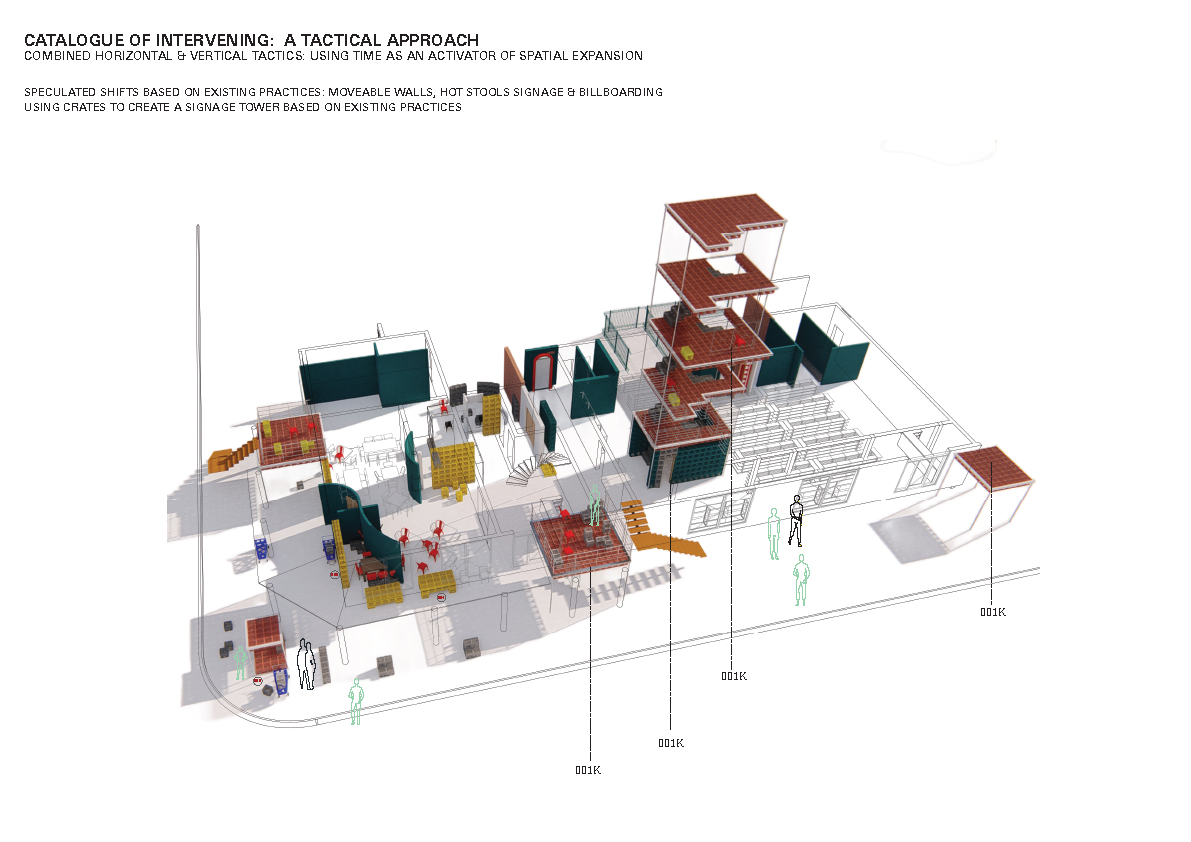
The Project is informed by AbdouMaliq Simone ‘s idea of “Intersections” (Simone, 2004, p.408) meaning, people’s ability to engage complex combinations of objects, practices, spaces and persons in order to “provide for and reproduce life or living in the city”. It is an exploration of the notion of infrastructure as established by how individual players are able to navigate and become accustomed to multiple transactional positions which can be spatial, economical, residential etc. The research exploration focuses on uncertainty and fragility as the ontological condition, the “isness” of Johannesburg. In particular, it examines the issues of power and how these are negotiated in space and time on the street intersections and their adjoining buildings. In studying the different intersections and conjunctions within the site, I came to discover that there exists within the site an organised and systematic way in which what is seemingly abstract space is created. That what seems haphazard is actually the bottom tier of an articulated socio economic and political system involved in and dictating the production of space within the site.
I am fascinated by the idea of collaboration exchange as I am myself a product of a hybrid and collaborative identity across geographies. Therefore, practices of spatial occupation that are temporal and aimed at negotiating uncertain belonging have always been intriguing. I therefore, focus on individual players within these spaces and in particular the MTN burner sim vendors as my subject for intervention. Exploring their tactics/ practices, by means of improvisation, adaptability and engagement of resources available to them in order to resist, negotiate, navigate and subvert the social, spatial and cultural structures and systems of power, (strategies) imposed upon them. It is this subversion of the system and or strategies that underpins the basis of my architectural proposition.
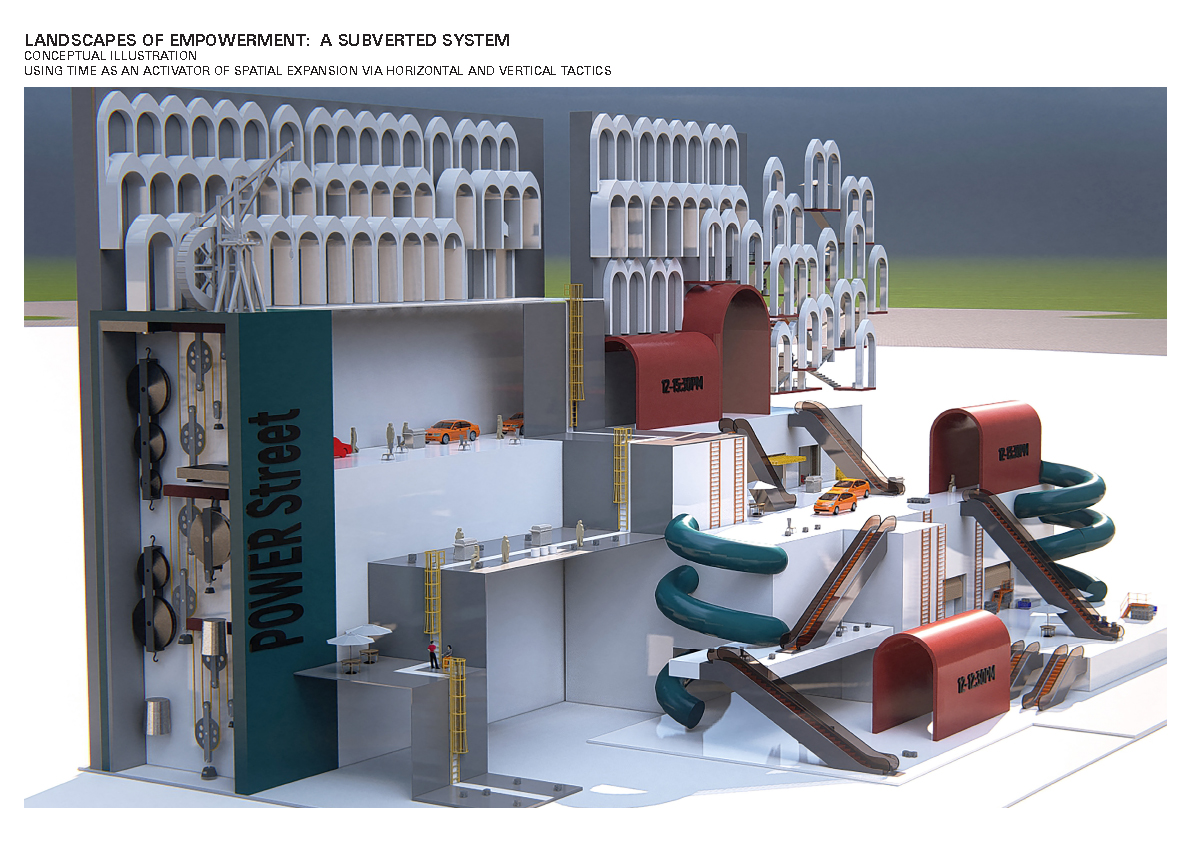
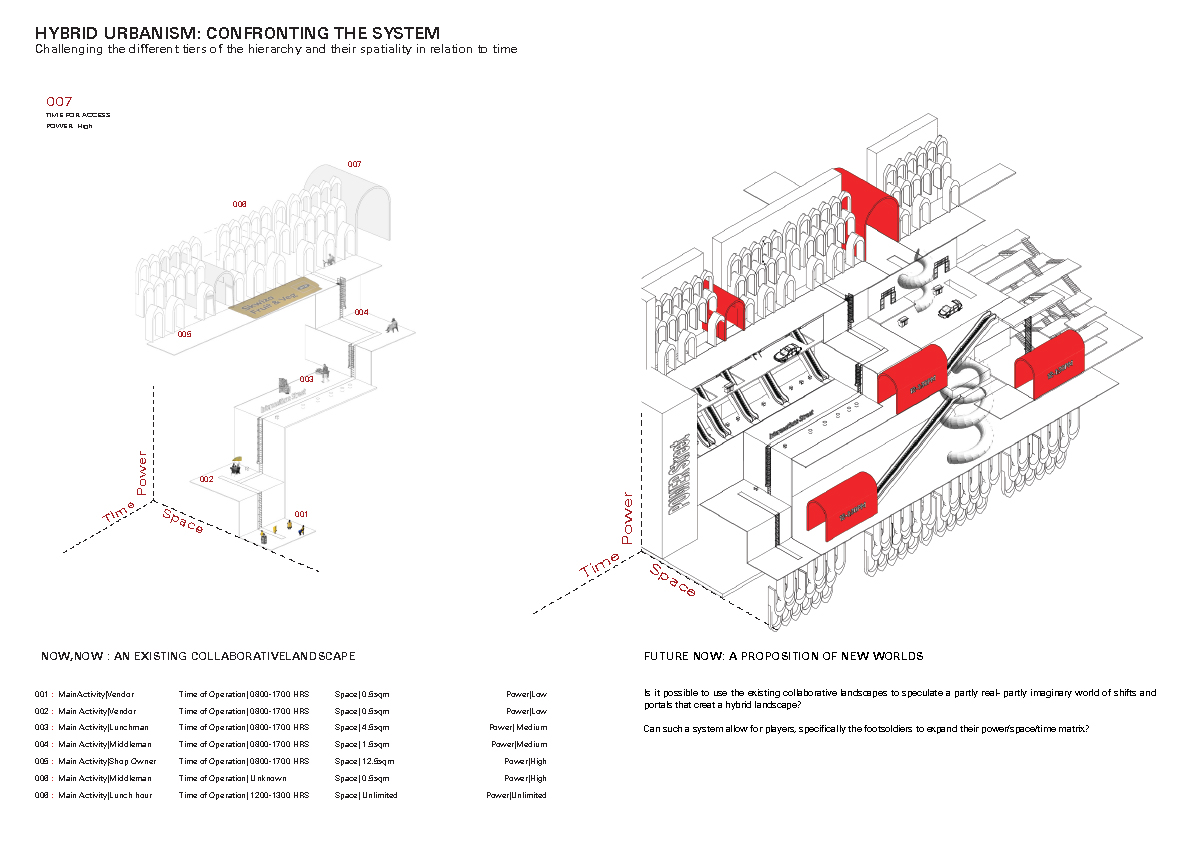
My final speculation imagines a partly real, partly imaginary world, where these practices open up portals to expand the ability of certain players to climb up the power matrix and enlarge their territorial space. This gives the opportunity to uncover amidst the seemingly place of “Ordinariness”, a possibility of a masking or veneering and an establishment of a hierarchical economic and spatial infrastructure capable of facilitating intersections of societies so that expanded spaces of economic and cultural operation are made available. This forms the basis of the project in providing an expandable landscape for operation, using time and veneering as a Tactic.