Building a Language for Infrastructure:
in Mayfair
My research this year is prefaced by the unit’s framing of “City Dreaming, and imagining the city of Johannesburg as something which is speculative, improbable, and yet real”. Through investigating infrastructure as a critical barometer of urbanisation, I hope to arrive at readings of the city, and use them to speculate alternative infrastructures that can support and enable the singular urbanism emerging in the contested landscapes of urban Johannesburg such as the unit site – the original farm Langlaagte.

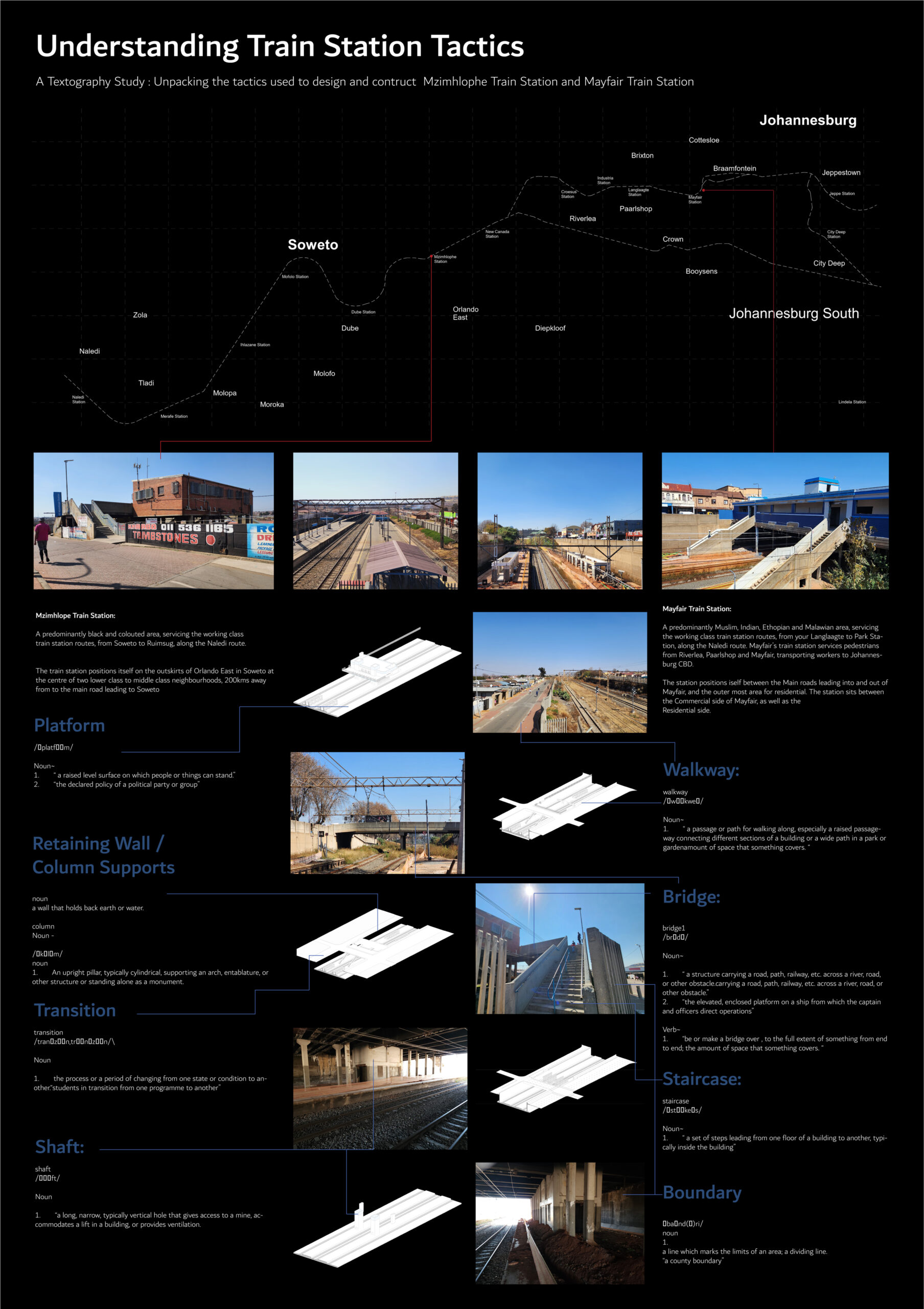
The research project locates itself within this indeterminate and fluid condition of existing transit infrastructure. Specifically, the railway infrastructure corridor which bisects the original Langlaagte farm, connecting the city centre to the southern reaches and to important ports on the coast such as Delgoa Bay.

After the discovery of gold in 1886, the railways were laid down to deal with the challenges of bringing equipment and men via ox wagon from the coast, and of extracting gold to the coast for export to Europe and America. These early infrastructural moves came to govern the spatial organization and evolution of the city, transporting goods, materials, and people to and from the mines.
From its inception as site of colonial extraction and modern industry, Johannesburg has been a place both formed out of and possessed by feverish dreams of gold, power, and speculation. Its location in the plateau hinterland of South Africa, its function as a European industrial base in Africa, its global and cosmopolitan population from the outset, its extreme cruelties, wealth, oppression, cruelties, and heroic resistances – all these are in their own way improbable.

In the past, infrastructure played a critical role in the establishment of Johannesburg as a city, giving rise to Johannesburg’s spatial organisation, financial development, goods, and services trade. Infrastructure is the backbone of any economic society, its role is to improve access to basic services such as clean water, electricity, transport, and goods, while providing a city with a long-term goal for sustainability.
My research this year investigates the role of infrastructure in contemporary Johannesburg, as it is no longer defined by a colonial dream, to enrich and develop one’s own empire but that of a cross pollination of histories, corrupted by practises of state capture, vandalism, and neglect.
The Design proposal this year will aim to propose an alternative infrastructure that might respond to the emergent practices of urbanism and support the development of a new dreamscape that is representative of the singular metropolitan type that is Johannesburg.